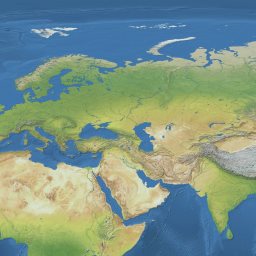
Quo Fuit places 5 dated presences for Ruhollah Khomeini across 4 places, from 1900 to 2016.
Each one keeps the sentence it was taken from and a link to its source.
Ruhollah Mostafavi Musavi Khomeini (17 May 1900 to 3 June 1989) was an Iranian politician and Shia cleric who served as the first supreme leader of Iran from 1979 until his death in 1989.Wikipedia, full article · CC BY-SA
Every dot is a place Ruhollah Khomeini is documented in, on a dated record. The interactive globe carries the full detail.
Where Ruhollah Khomeini was documented, and when
17 May 1900exact date
Khomeynattested“According to his birth certificate, Ruhollah Mostafavi Musavi Khomeini, whose first name means "spirit of Allah", was born on 17 May 1900 in Khomeyn, Markazi province, although his brother Mortaza (later known as Ayatollah Pasandideh) gi…”source: Wikipedia: Ruhollah Khomeini
Iranattested“In a talk at the Fayzieah School in Qom a few months after his return to Iran (on 30 August 1979), Khomeini threatened his democratic opponents: "Those who are trying to bring corruption and destruction to our country in the name of demo…”source: Wikipedia: Ruhollah Khomeini
3 June 1989exact date
Jamaranattested“After spending eleven days in Jamaran hospital, he died on 3 June 1989 after suffering five heart attacks in ten days.”source: Wikipedia: Ruhollah Khomeini
2016year
Iranattested“government documents — "diplomatic cables, policy memos, meeting records" declassified in 2016 and published by the BBC — indicate Khomeini did send messages to the US two weeks prior to the revolution, and that these may have been succe…”source: Wikipedia: Ruhollah Khomeini
Open Quo Fuit to see these 5 presences on the
globe, filter them by date, and follow the journey year by year.
Other places tied to Ruhollah Khomeini in the record
In each of these, a source puts Ruhollah Khomeini and the place in the same dated sentence without stating
that Ruhollah Khomeini was there. They are kept apart from the timeline above for exactly that reason:
a mention is not a presence, and Quo Fuit does not quietly promote one into the other.
1830year
Najafmentioned“He left Lucknow in 1830 on a pilgrimage to the tomb of Ali in Najaf, Ottoman Iraq (now Iraq), and never returned.”source: Wikipedia: Ruhollah Khomeini
1830year
Lucknowmentioned“He left Lucknow in 1830 on a pilgrimage to the tomb of Ali in Najaf, Ottoman Iraq (now Iraq), and never returned.”source: Wikipedia: Ruhollah Khomeini
1834year
Khomeinmentioned“In 1834, Seyyed Ahmad Musavi Hindi visited Iran, and in 1839, he settled in Khomein.”source: Wikipedia: Ruhollah Khomeini
1834year
Iranmentioned“In 1834, Seyyed Ahmad Musavi Hindi visited Iran, and in 1839, he settled in Khomein.”source: Wikipedia: Ruhollah Khomeini
1929 to 1982period
Tehranmentioned“In 1982, after listening to a half-hour-long speech on the Quran by him, a Muslim scholar from South Africa, Sheikh Ahmad Deedat gushed: In 1929, or possibly 1931, Khomeini married Khadijeh Saqafi, the daughter of a cleric in Tehran.”source: Wikipedia: Ruhollah Khomeini
1929 to 1982period
South Africamentioned“In 1982, after listening to a half-hour-long speech on the Quran by him, a Muslim scholar from South Africa, Sheikh Ahmad Deedat gushed: In 1929, or possibly 1931, Khomeini married Khadijeh Saqafi, the daughter of a cleric in Tehran.”source: Wikipedia: Ruhollah Khomeini
3 June 1963exact date
Feyziyehmentioned“On the afternoon of 'Ashura (3 June 1963), Khomeini delivered a speech at the Feyziyeh madrasa drawing parallels between the Caliph Yazid I, who is perceived as a "tyrant" by Shias, and the Shah, denouncing the Shah as a "wretched, miser…”source: Wikipedia: Ruhollah Khomeini
5 June 1963exact date
Tehranmentioned“On 5 June 1963 (15 of Khordad) at 3:00am, two days after this public denunciation of the Shah, Khomeini was detained in Qom and transferred to Tehran.”source: Wikipedia: Ruhollah Khomeini
November 1963month
Iranmentioned“A CIA analysis report titled "Islam in Iran", also indicates that years earlier, in November 1963, Khomeini (while under house arrest for rallying opposition to the shah's White Revolution reforms as a foreign inspired "attack on Islam")…”source: Wikipedia: Ruhollah Khomeini
4 November 1964exact date
Bursamentioned“Initially, he was sent to Turkey on 4 November 1964 where he stayed in Bursa in the home of Colonel Ali Cetiner of the Turkish Military Intelligence.”source: Wikipedia: Ruhollah Khomeini
4 November 1964exact date
Turkeymentioned“Initially, he was sent to Turkey on 4 November 1964 where he stayed in Bursa in the home of Colonel Ali Cetiner of the Turkish Military Intelligence.”source: Wikipedia: Ruhollah Khomeini
October 1965month
Najafmentioned“In October 1965, after less than a year, he was allowed to move to Najaf, Iraq, where he stayed until 1978, when he was expelled by then-Vice President Saddam Hussein.”source: Wikipedia: Ruhollah Khomeini
1970year
Najafmentioned“In early 1970, Khomeini gave a series of lectures in Najaf on Islamic government, later published as a book titled variously Islamic Government or Islamic Government: Governance of the Jurist (Hokumat-e Islami: Velayat-e faqih).”source: Wikipedia: Ruhollah Khomeini
1977year
Najafmentioned“Mostafa, the elder son, died in 1977 while in exile in Najaf, Iraq with his father and was rumored by supporters of his father to have been murdered by SAVAK.”source: Wikipedia: Ruhollah Khomeini
Two people documented in the same place in the same year is a correlation, not a meeting.
Quo Fuit will never say they met without a source that says so.
How to read this page
Every line above is a dated fact taken from a source, with the sentence it came from and a link
back to it. Nothing is inferred, and a gap in the record is not evidence that someone was elsewhere.
A tag says how the fact is carried by its source: documented a structured,
explicitly dated record, attested a sentence that states the person was there,
mentioned a sentence that ties the person to the place without stating presence.
Sentences quoted from Wikipedia are available under CC BY-SA 4.0. Public domain books come from
Project Gutenberg. Quo Fuit claims no rights over these sources.
See Ruhollah Khomeini on a 3D globe, filter the record by date, and cross this life with another to find
where the two overlap.